Getting started with Individual Fundraising
In this article, we explore key considerations for the creative and cultural sector in developing individual fundraising. We provide good practice examples, resources, and options for further free support.
1. Start by making the case for donations
A good starting point is by making the case, looking at why an individual should donate to your organisation or business.
ACE Chair, Sir Nicholas Serota makes the case for giving to the arts:
“What makes the arts deserving of [their] donations? The answer is practical and straightforward – the arts, culture and creativity change lives. They promote wellbeing, ease loneliness, enable individuals and communities to tell their stories, among many other benefits.”
Reflecting on the impact of your work and how it makes a difference to your audiences can help you to shape your approach and create a case for generating donations. Messaging needs to be simple to persuade potential donors and ensure that everyone working with you can communicate your rationale confidently and consistently.
2. Establish donor motivations
Seek to build a relationship with your existing and potential donors so you can understand their motivations. As you develop your case for support, knowing what resonates with your audiences and how you connect with them will be key to success.
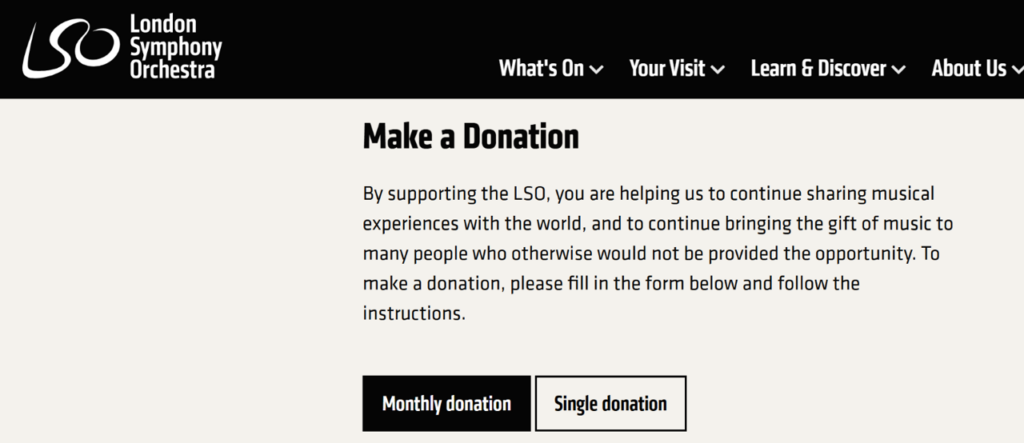
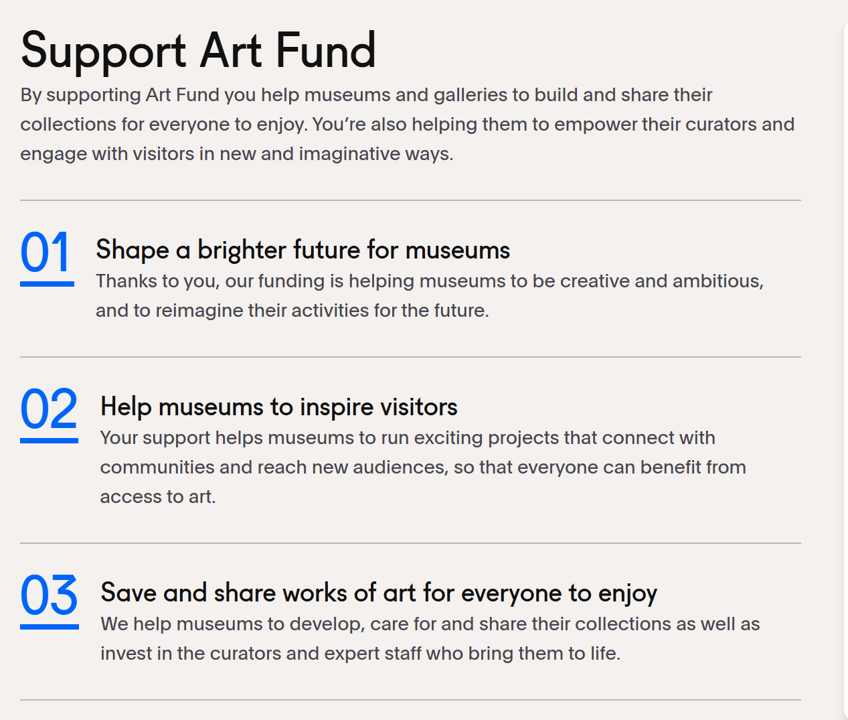
The two examples below illustrate how the London Symphony Orchestra and Art Fund have distilled the value of their work and explained how a donation can change people’s lives:
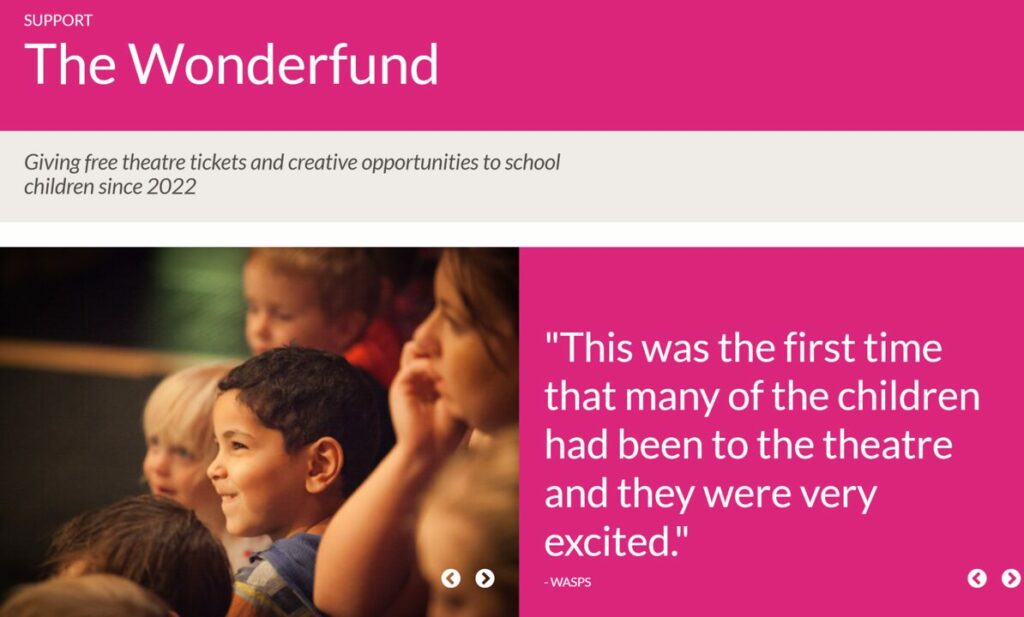
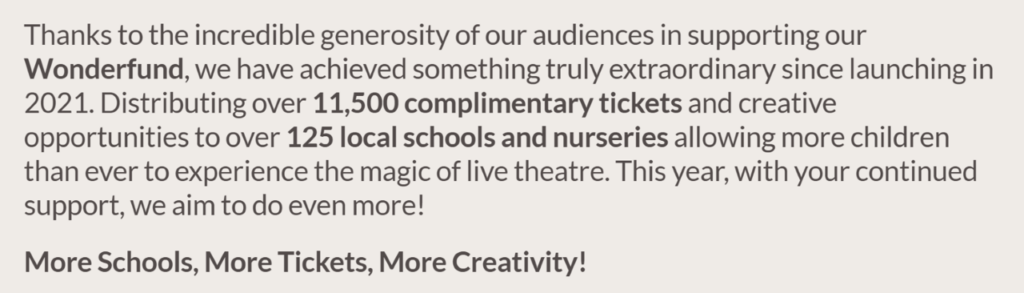
Rather than making the case for general donations, you may want to raise money for a specific project or programme of work. Some organisations focus on their outreach and education activity to persuade donors. For example, Bath Theatre Royal’s Wonderfund encourages donations to provide free theatre tickets and creative opportunities to school children. The image below shows how they have used quotes, imagery, and the impact of donations to demonstrate the direct impact of donations:
Remember, when donations are generated for a specific project or programme of work, it is classed as restricted funding. The monies raised can only be used for that specific purpose and not for any other projects or general costs.
Tech Champion for websites, Andy Leitch, can help you develop your website design and functionality to make it more effective. Book a one-to-one to see how he can help.
3. Find potential donors
It is much harder and more costly to generate support from people who don’t know your organisation or business. You are therefore looking to target individuals who have already been in contact with you, building on an existing relationship. The loyalty funnel can help to visualise the five stages of building a relationship with donors. In theory, you ‘funnel’ your potential donor through the five stages starting with awareness:
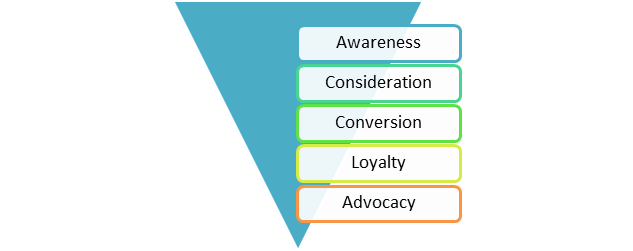
Asking for donations at the ‘awareness’ or ‘consideration’ stage of the loyalty funnel might feel a bit like someone asking you to get married when you have only just met (and will probably have a similar success rate). However, if you can target your potential donors after the conversion stage, you are far more likely to generate a positive response.
Examples of conversion could be an individual engaging with content on a newsletter; registering for an event; or something of higher financial value such as making a purchase. The greater the level of engagement, the more frequent that engagement occurs, and the higher the value of engagement, are all indicators that can be used to target potential donors.
Seed the idea of donations from the start of the relationship by highlighting fundraising aims whenever they sign up to hear from you. Using a double opt-in process, where users confirm their subscription via an automated email, builds trust and ensures that your contact lists consist of more engaged individuals.
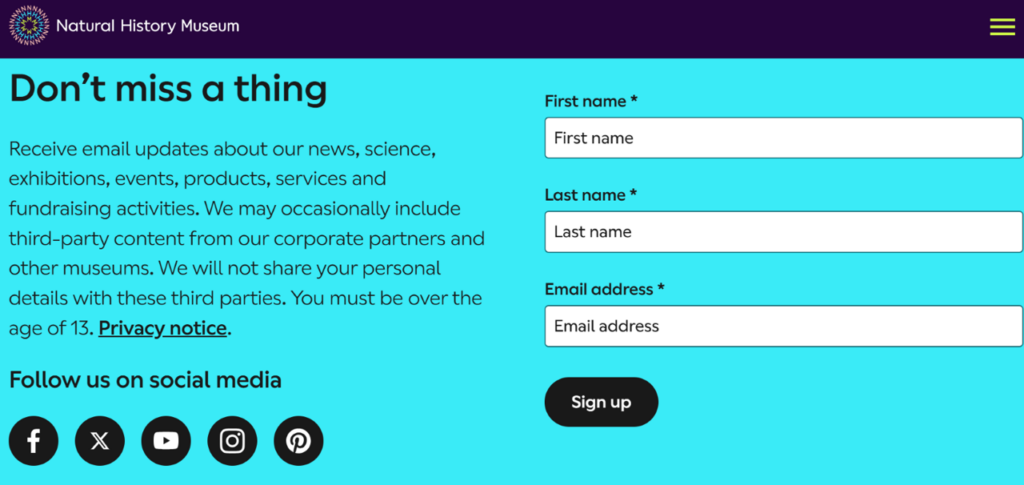
For example, the Natural History Museum’s newsletter sign-up form includes permission to email about fundraising activities as part of their core aims and goals, listed alongside exhibitions, events, products, and services:
Booking and ticketing functions are also invaluable tools for identifying potential donors and targeting high value customers who are more likely to give. Adding the option to add a donation as part of a registration/purchase process can be an easy way to generate funds.
Free access and events pose a challenge because, unlike the booking or ticketing pipeline, there is not necessarily a process to collect contact data from attendees. Recognising the value of collecting contact data of existing audiences, many organisations with permanent free collections or events have now introduced ticketing. The image below shows how the National Portrait Gallery have been able to ask for donations after visitors have booked a time slot for free entry tickets:
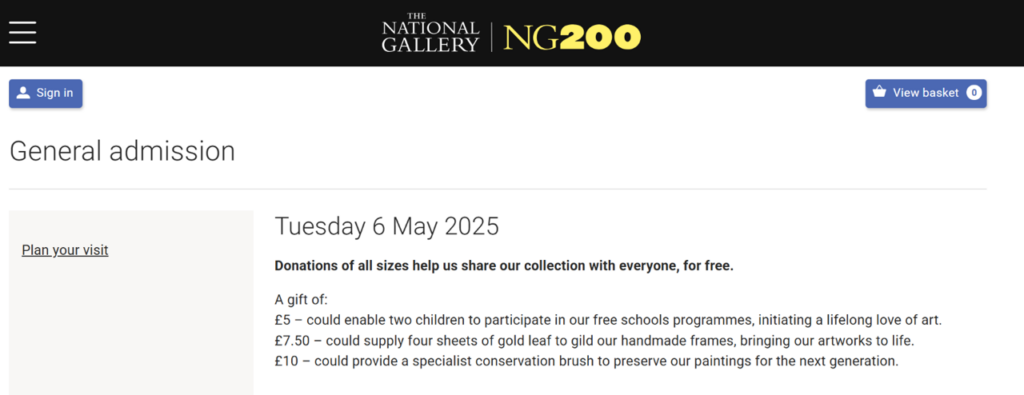
Not only has the National Gallery been able to build relationships with visitors to its free collection, which formerly didn’t exist, but the ticketing process has also generated donation revenue and enabled cross-selling and up-selling.
Tech Champion for CRM and Ticketing, Adam Sykes, can help you get more out of existing CRM and ticketing systems. Book a one-to-one to see how he can help.
4. Understand what donors want
First things first, donors will need to be thanked. Email marketing can deliver this easily and effectively. The fact of being thanked is more important than the way you thank them.
“The most important thing you’ll ever do for your donors is say thank you. Just about every charity leader or fundraiser knows the importance of thanking donors—not just as an expression of gratitude and good manners, but as a way of building relationships.” – Charities Aid Foundation
Here is an example of a donation thank you email from the Tate:
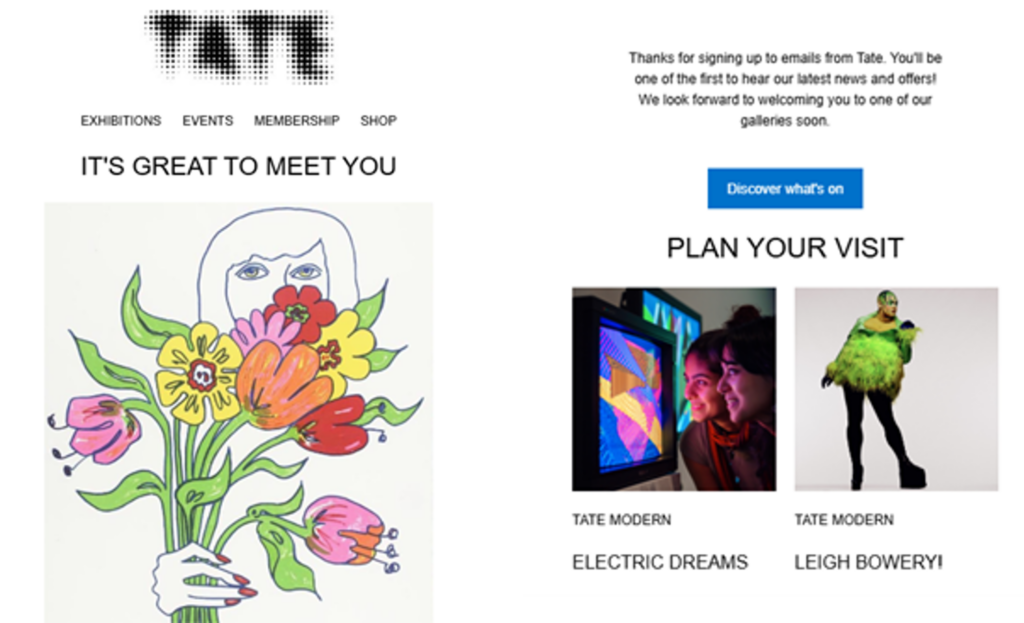
Communicating the impact supporters are making also plays a significant role. Sharing content and stories about how your work has positively impacted or made a difference in a person’s or family’s life helps illustrate that impact. Where possible personalise your messaging to build strong relationships with your donors. Email marketing is a great way of keeping donors engaged and allowing messaging to be tailored to the individual.
One of the strategic decisions regarding fundraising is whether regular donors should be offered something in return for their donations. Several larger organisations create tiered donation levels and/or membership schemes. These decisions will be based on resources and the ability to service different schemes.
Gift Aid may also affect your decision about what to offer donors. If you register as a charity with HMRC and ask the donor to complete a Gift Aid form, you can claim an additional 25% from the government on top of their donation – £100 gift becomes £125. However, there are rules around when a donation is classed a gift: for Gift Aid to apply you cannot give donors anything back that has a monetary value. To find out more about the rules around Gift Aid, visit Claiming Gift Aid as a charity.
Tech Champion for Email Marketing, Jacqueline Ewers, can help you to target your contacts by email and tell your story more effectively. Book a one-to-one to see how she can help.
5. Use the most effective channels to build donor relationships
Email is the best performing marketing channel. According to the 2020 Global Trends in Giving Report1 26% of donors say email is the channel that most inspires them to give, above social media, websites, and print materials. Return on Investment is high, with a report from the Chartered Institute of Fundraising (CIOF) in 2022 showing that UK nonprofits raised an average of £66 for every 1,000 fundraising emails.3
CIOF recommendations for email marketing are to focus on four key areas: growing contacts, automated email journeys, increasing personalisation of messaging, and optimisation through testing and tracking.
Direct mail, sending information by post, can also be a valuable channel for fundraising: Neon One’s ‘Donors: Understanding the Future of Individual Giving’4, listed direct mail as the second most preferred channel after email. A key consideration for direct mail is permission to contact and cost. Under GDPR, to be able to send direct mail regarding fundraising, donors must have given permission for you to do so.
Here are the summary direct mail guidelines from the Information Commissioner’s Office who uphold GDPR and PECR (Privacy in Electronic Communications Regulations):
Do we need consent for postal marketing?
- If you are sending direct marketing by post, you don’t need consent.
- However, if you’re putting someone’s name on a letter or flyer, you’ll need a lawful basis for using their personal data. This also applies if you know the name or other information which can identify the person you’re sending the marketing to.
- Make sure you’re clear and open about how you will use people’s information from the outset. As with all forms of direct marketing you also must stop sending direct marketing by post if the person asks you to stop.
Read full ICO postal marketing guidelines
Social media was the driver for 6% of donations, according to CAF’s UK Giving Report 2025, increasing to 12% among 16–24-year-olds. Fundraising through social media presents several key challenges in building donor relationships, further complicated by the rapidly changing environment. Charity Digital5 suggests that social media must be used strategically, considering donors and demographics. Understanding the strengths of each social media channel in terms of whom they reach and how they engage people is essential to realising their potential.
Tech Champions for Social Media and Paid Social Media, Katy Farrell and Nicola Barratt, can help you with social media targeting. Book a one-to-one to see how they can help.
6. How do I know which fundraising approach is working?
In addition to monitoring numbers of active, lapsed, new, and regular supporters, evaluating your wider digital fundraising activity provides a unique opportunity to analyse, test, and learn. Whether it is examining your existing donors to improve targeting, analysing website source traffic, tracking visits to donor webpages, or evaluating email marketing response rates, these activities offer relatively simple ways to refine your fundraising efforts and focus on what works.
Tech Champion for Data Analytics and Insight, James Akers can help you use data to create insight which can save time and inform decision-making. Book a one-to-one to see how he can help.
You can also ‘magpie’ good practice from other people’s fundraising campaigns. Consider signing up or donating to other people’s campaigns to gain ideas that can be useful in planning your approach and shaping your messaging.
The good news is there is a wealth of experience to draw on. Below are selected resources and support to help you with your next steps in individual fundraising.
Resources:
Arts Council England Decision Science
Fundraiser Help The Art of the Ask
Charity Digital – Digital Fundraising
Recap: Key steps to get started with Individual Fundraising
- Make the case for donations
Clearly articulate why your organisation deserves support—highlight the impact of your work and keep messaging simple and consistent.
- Understand donor motivations
Build relationships to learn what inspires your supporters. Tailor your case for support to resonate with their values and interests.
- Identify potential donors
Focus on individuals already engaged with your organisation. Use tools like ticketing, CRM, and email sign-ups to build and track relationships.
- Acknowledge and thank donors
A prompt and sincere thank you goes a long way. Use email marketing to express gratitude and share the impact of their support.
- Choose the right channels
Prioritise email for its high ROI but also consider direct mail and social media based on your audience demographics and preferences.
- Measure what works
Track engagement, donor behaviour, and campaign performance to refine your approach and focus on what delivers results.
- Use tools and learn from others
Draw inspiration from successful campaigns and tap into free resources and expert support from Tech Champions.
Further support
The Digital Culture Network is here to support you and your organisation. Our Tech Champions can provide free one-to-one support to all creative and cultural organisations who are in receipt of, or eligible for, Arts Council England funding. If you need help or would like to chat with us about any of the advice we have covered above, please get in touch. Sign up for our newsletter below and follow us on LinkedIn and X (Twitter) @ace_dcn for the latest updates.