What is Bluesky and should it be a part of your social media strategy?
Bluesky is a text-based, social media alternative to platforms like X (formerly known as Twitter) and Meta’s Threads. But what do you need to know about using the micro-blogging platform? And as artists and creative and cultural organisations, should you be incorporating it into your social media toolkits?
What is Bluesky?
Bluesky has been around since 2019 but was originally invite-only. In 2024, the app opened sign-ups to everyone and began to grow as an alternative to X. If you’ve already got an account, then you’ll probably notice a lot of similarities to the layout and functionalities of old Twitter.
Posts on Bluesky can contain up to 300 characters of text, links, and up to four photos or one video (of up to three minutes).
A key feature of Bluesky is that it’s not reliant on an algorithm – posts can be seen chronologically, something that other social media platforms used to offer. In addition, the platform doesn’t offer any advertising.
The Bluesky app is available on Android and iOS and a desktop browser version is also available.
Which audiences can you reach on Bluesky?
After an initial boom in sign-ups, Bluesky’s user base has continued to grow slowly and is now estimated to be around 40 million registered users. However, only around 10% of users are thought to be consistently active each day.
So, the numbers are significantly smaller than on Meta’s Threads and Elon Musk’s X, which have hundreds of millions of users.
This can be a positive thing, as Bluesky’s smaller user base allows for a more community feel and meaningful interactions. As noted by Oban International, “Bluesky’s smaller, close-knit communities offer brands a chance to focus on authentic connections rather than mass advertising.” This intimate setting can create a safer and more pleasant space for users to share and connect.
The downside though is that your audience may not be on here. Before setting up an account we would suggest checking whether your partners, competitors, or other relevant organisations and/or artists are on Bluesky. If they’re not, is it worth you joining? If you have the resources, then you could use this as an opportunity to test engagement and connect with different audiences.
Who is on Bluesky?
Bluesky tends to attract:
- Younger users (many under 35)
- Communities such as scientists, academics, museums, libraries, and other intellectual users
- People looking for alternatives to algorithm-driven feeds and advertising
If politics are a factor for you when choosing a platform, then research analysing Bluesky’s network and user interactions found that users are predominantly left centre leaning.
10 key features of Bluesky
- Unlike X and Threads, Bluesky offers a chronological timeline, so if you’re following someone you will see all of their posts in order. This is particularly useful for live posting from events, such as conferences or award ceremonies.
- You can create and follow feeds on different topics. For example, you might be looking to follow a feed about libraries, museums, or musicians. Choose feeds to follow by entering relevant keywords into the ‘Discover New Feeds’ section (look for the hashtag icon top right of the screen). Once you find a feed you’d like to follow, pin it to the top of your app. You can do this with multiple feeds.
- Lists are a feature you can use to group together accounts. For example, you might want to create a list of industry experts or artists in Manchester. You can publish these lists on your profile. You can also find and/or create moderation lists of accounts that you don’t want to interact with. This allows you to auto mute or block everyone on the list. This can make for a more peaceful online experience.
- Starter packs are a brilliant feature of the platform that are designed to help newcomers find relevant accounts and feeds to follow. Starter packs are essentially a group of similar accounts or users posting about a particular topic, which you can follow in order to populate your home feed when you’re new to the platform. You can create your own starter packs too – for example, you could create one to list the cultural organisations in your hometown who are using the app.
- Bluesky currently doesn’t have paid advertising, meaning your feed isn’t cluttered with promoted content. This means you can focus on having conversations and forming connections.
- Currently there aren’t any in-platform analytics, however there is an independent free tool called Bluesky Meter that you can use to look at the analytics for any account without needing to register.
- While you can’t schedule posts on the platform itself you can on third-party social media schedulers like Metricool, Planly, etc.
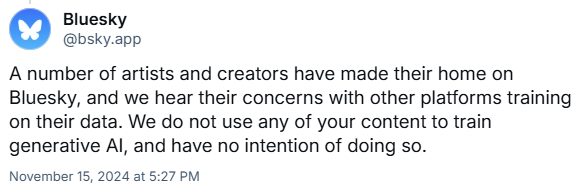
- They aren’t training generative AI with your content. Back in November 2024, Bluesky announced “A number of artists and creators have made their home on Bluesky, and we hear their concerns with other platforms training on their data. We do not use any of your content to train generative AI, and have no intention of doing so.”
- Unlike most social media platforms, Bluesky welcomes you sharing links in your posts and as a result is becoming a good source of web traffic. In December 2024 some publishers reported seeing 3 or 4 times the referral traffic from Bluesky compared to X and Threads. If traffic to your website is very important to your objectives, then this could be a platform to trial.
- Bluesky is a decentralised social media platform, which means that no single company or individual controls it.
What does Bluesky being decentralised mean?
Bluesky runs on a system called the AT Protocol, which allows different servers—like separate communities—to exist while still staying connected within the network. Each server can have its own rules, but users can interact across the network. It’s like how email works – you can have a Gmail account but email your friend who is using Outlook, or another friend using Yahoo.
This makes the platform more open, giving developers and individuals more control over the experience while making the network’s workings more transparent. Despite being decentralised, Bluesky isn’t part of the Fediverse like some other decentralised social media platforms. This means you can’t post to other social media apps from Bluesky.
How does the platform being decentralised affect the average user experience? If you’re not looking to create your own server, custom algorithms, or develop new tools and apps, then honestly you won’t really notice a difference. It just means there are more options available for those that do.
Should creative and cultural organisations and individuals join Bluesky?
So, should creative and cultural organisations or artists add Bluesky to their social media portfolio?
There are two things to consider before you start an account on any new social media site:
-
Do you have the capacity for a new platform?
Do you have enough staff resources to add another social media platform into your portfolio? Every new platform takes up resources, so consider the time and skills required to create posts, engage with the audience, and build up a new online community. Bluesky is at its heart a text-based platform, so the goal is to have conversations, not just post and disappear.
If you don’t have capacity, but think that Bluesky would be a useful addition, then is there another platform you can shelve or spend less time on?
-
Are your audience here?
The audience on Bluesky is growing but it has slowed down since late 2024. We know that this platform is significantly smaller than its rivals Threads and X, so is it the right platform to speak to your audience?
The main thing to do is to check whether there are others you would like to interact with on here – look for your partners, similar organisations, competitor venues, other artists, before making your decision.
Further support
The Digital Culture Network is here to support you and your organisation. Our Tech Champions can provide free one-to-one support to all creative and cultural organisations who are in receipt of, or eligible for, Arts Council England funding. If you need help or would like to chat with us about any of the advice we have covered above, please get in touch. Sign up for our newsletter below and follow us on LinkedIn and X (Twitter) @ace_dcn for the latest updates.